An interesting flipping coin question
Problem statement
You have a fair coin, which means a flip result could be tail(T) and head(H), and their probability is 50%.
You cast the coin until the coin until have a pattern “THTHT” or “THHHT”, which one is easier to get? And their probability?
First thought
Lots of people will think they are identical intuitivly because “T” and “H” both have same probability to get. Then their probability is $\frac{1}{2}^5$.
But then this idea will disappear because of the method above is to extra 5-times result from an infinite sequence, but the statement is to construct a sequence to see which pattern we can get.
Markov chain
We can use different state to represent the status for each step:
Each toss has an equal probability (0.5) of being Heads (H) or Tails (T). Based on this, we define the transitions between states:

From State 0:

On H: Move to State H (probability 0.5).
On T: Remain in State 0 (probability 0.5).
From State H:

On H: Remain in State H (probability 0.5).
On T: Move to State HT (probability 0.5).
From State HT:

On H: Move to State HTH (probability 0.5).
On T: Move to State HTT (probability 0.5).
From State HTH:

On H: Move to State H (probability 0.5).
On T: Move to State HTHT (probability 0.5).
From State HTHT:

On H: Move to State A (sequence HTHTH achieved) (probability 0.5).
On T: Move to State HTT (probability 0.5).
From State HTT:

On H: Move to State H (probability 0.5).
On T: Move to State HTTT (probability 0.5).
From State HTTT:

On H: Move to State B (sequence HTTTH achieved) (probability 0.5).
On T: Move to State 0 (probability 0.5).
States A and B are absorbing; once entered, the process stops.
The markov chain graph looks like:
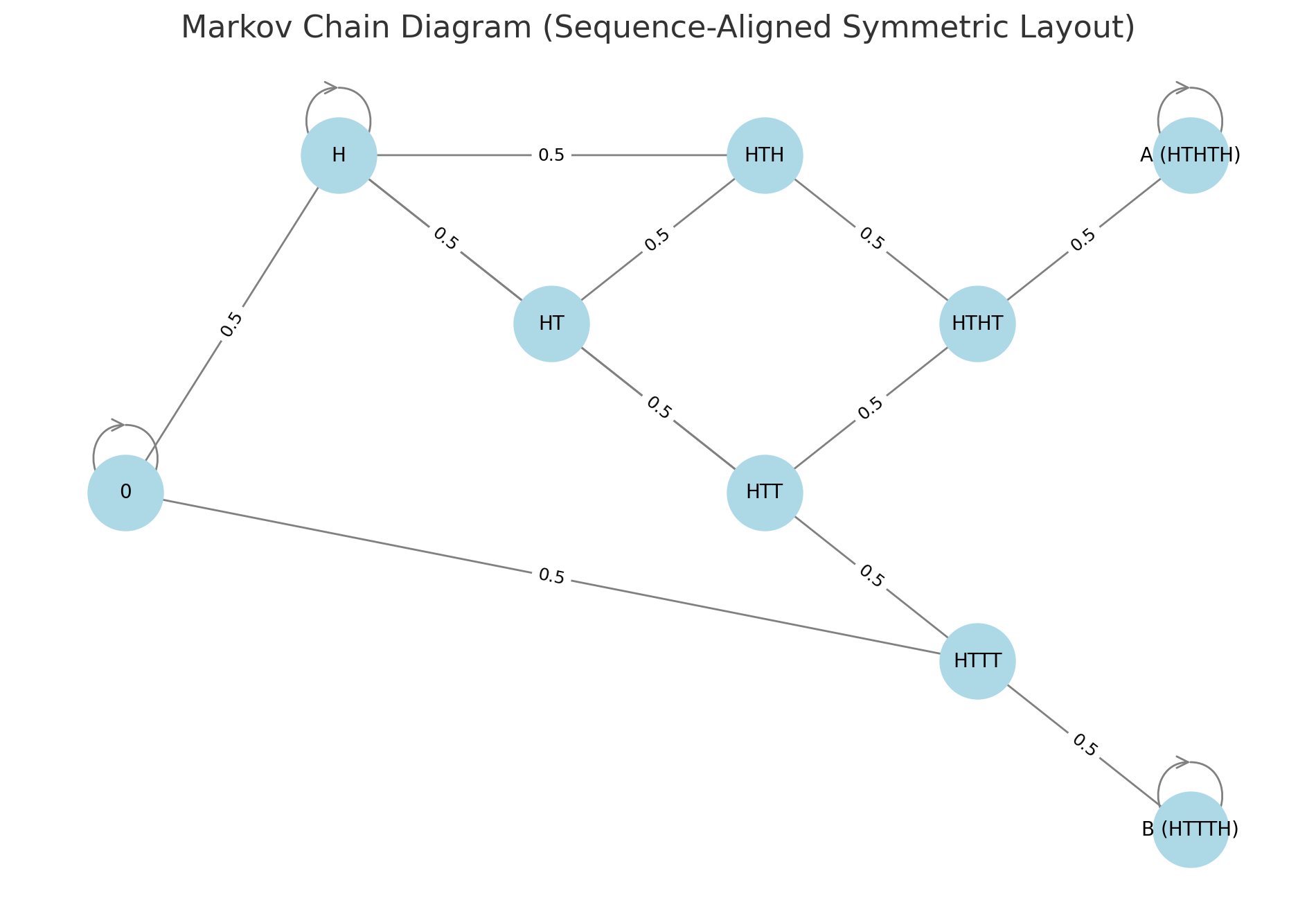
Intuitivly, we can see the path to HTHTH, at state “HTHT”, it could transfer to “HTT”, which belongs to B state. Then we could say it’s more likely to get B rather than A.
Final calculation
We assume the probability reaching A is u. Then:
Based on the transitions, we create equations for u_i:
- From State 0: $u_0 = 0.5 \times u_H + 0.5 \times u_0$ Simplifies to: $u_0 = u_H$
- From State H: $u_H = 0.5 \times u_H + 0.5 \times u_{HT}$ Simplifies to: $u_H = u_{HT}$
- From State HT: $u_{HT} = 0.5 \times u_{HT} + 0.5 \times u_{HTT}$
- From State HTH: $u_{HTH} = 0.5 \times u_H + 0.5 \times u_{HTT}$
- From State HTHT: $u_{HTHT} = 0.5 \times 1 + 0.5 \times u_{HTTT}$ (Since reaching State A has a probability of 1)
- From State HTT: $u_{HTT} = 0.5 \times u_H + 0.5 \times u_{HTTT}$
- From State HTTT: $u_{HTTT} = 0.5 \times 0 + 0.5 \times u_0$ (Since reaching State B has a probability of 0 for reaching A)
Then the probability before reaching before B is $\frac{4}{9}$ And the probability to get A is $1-\frac{4}{9} = \frac{5}{9}$
Then A is more easy to get.